Is My Engineering Good Enough?
“Is my engineering good enough?” I get a version of this question from a CEO almost every week.
It almost always starts with AI. Are we using it as much as everyone else? Then we have the long debate: AI is not a button you turn on. It is not a Claude Code license, or a seat count, or a number you can buy. It is changing the behavior of a whole team at scale, and that is slow, messy, and hard to see from the outside. The question is genuinely complicated, and we could talk about it for an hour.
But the debate never ends there
It ends with some version of this: “Anthropic is shipping so much faster than we are. I keep seeing startups delivering at insane speed. I think my engineering is behind.”
That sentence is the actual reason for the meeting. Everything before it was warm-up.
This is a trust problem, not an AI problem
What I eventually realized is that this is not really a question about AI adoption. It is a trust issue between the management of a company and an engineering org going through a transition. The CEO cannot see inside engineering, the ground is moving under everyone, and the gap between what the team says and what the CEO feels keeps widening.
You cannot argue your way out of it
When that trust gap opens, you can try to answer a non-technical CEO with AI spend, pull request counts, or DORA metrics. I have watched it fail every time. Those are inputs and pipeline mechanics. They do not answer the only question the CEO is actually asking, which is “are we behind, or not?” A chart of deploy frequency does not settle a feeling.
The only thing that works is a benchmark
The one move I have seen actually land is showing a benchmark against other companies at a similar stage, size, and trajectory. Not against Anthropic, and not against the loudest startup on the timeline. Against peers. It reframes the conversation from “do I trust my CTO’s story” to “here is where we sit, and here is the trend.”
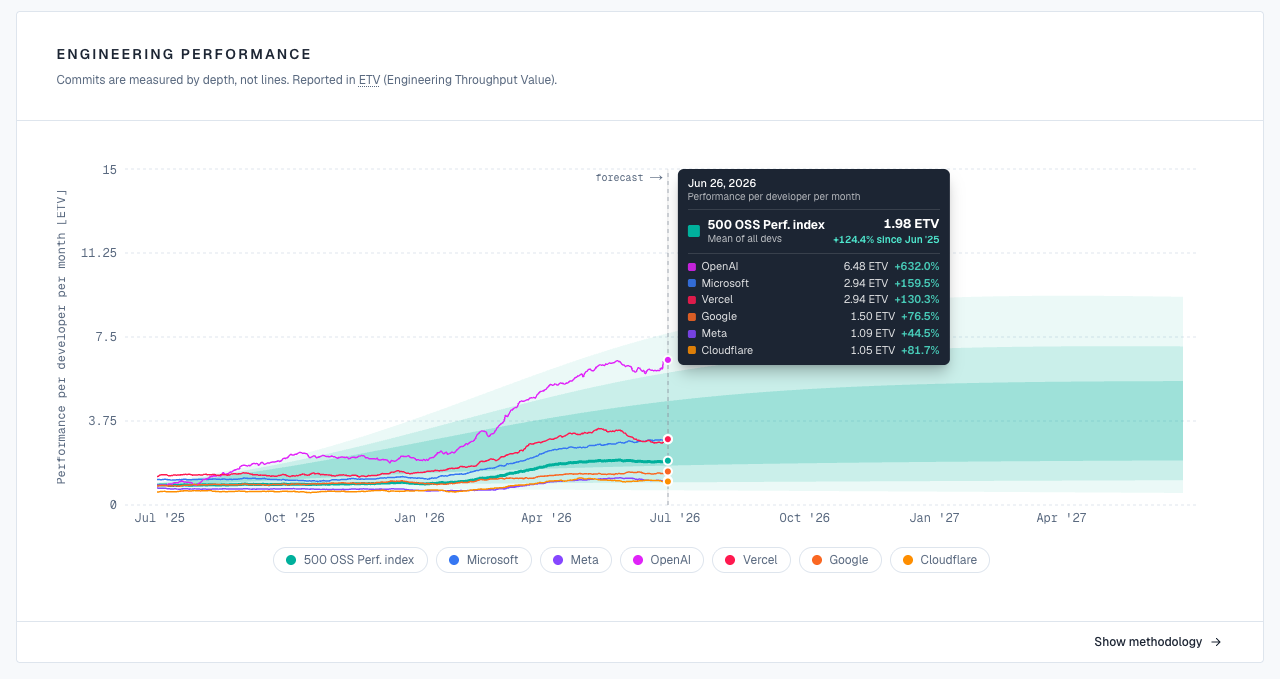
The moment the conversation has a shared axis, it stops being a debate about feelings. A non-technical CEO can read a line going up next to its peers. That is the whole point: give them something relative they can see, not an internal metric they have to take on faith.
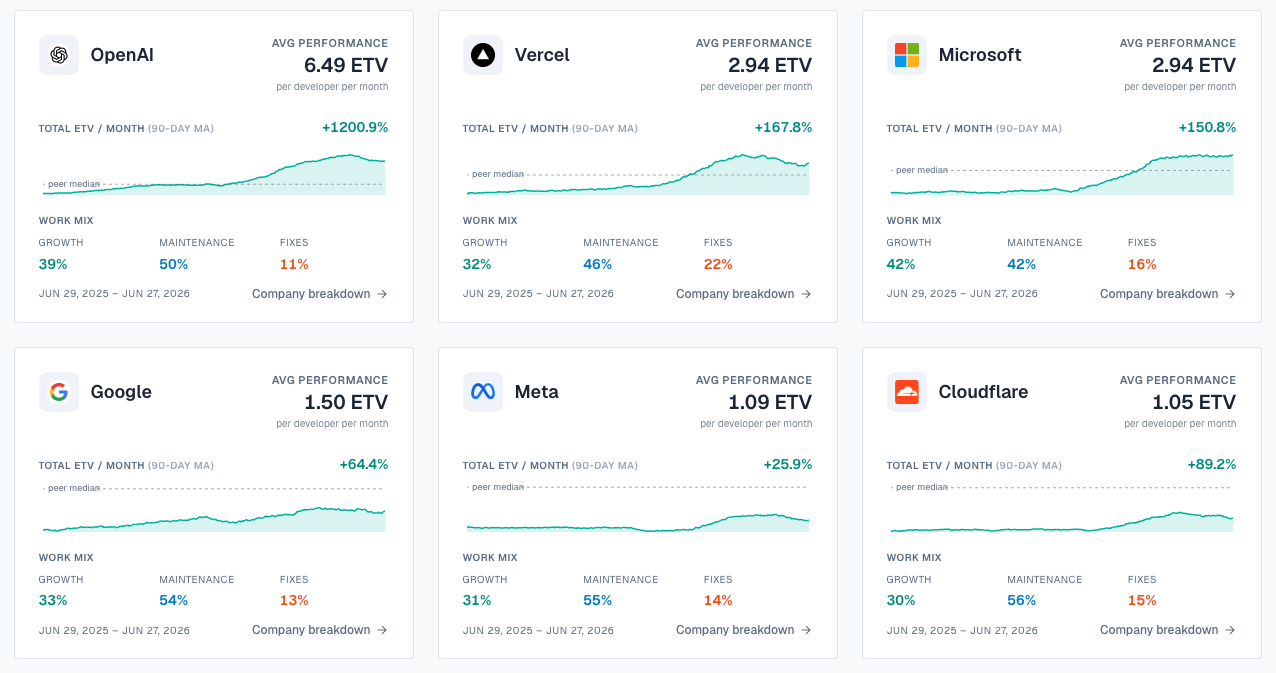
One honest aside: a benchmark calms the room even when the comparison set is rough. As long as the year-over-year growth looks similar to the peers, the panic drains out of the conversation. The shape of the trend does more work than the precision of the set.
The real reason they are asking
Here is the part nobody says out loud. When a CEO starts asking whether engineering is good enough, they are often deciding whether to replace their CTO. That is the stake under the small talk.
And the CTOs who survive that conversation are the ones who walk in with the benchmark first. Not the ones who get shown one. If you bring the number, you are the person measuring reality. If someone brings it to you, you are the thing being measured.
So if you lead engineering and you have felt this question coming, do not wait to be handed the answer. Go get the benchmark, on your own terms, before the meeting that is really about you.
Frequently asked questions
- How do I know if my engineering team is good enough?
- Comparisons to absolute names like Anthropic are noise. The signal is a benchmark against companies at a similar stage, size, and trajectory: where your output per developer sits versus peers, and whether the year-over-year trend is keeping pace.
- Why don’t DORA metrics or PR counts convince a non-technical CEO?
- They measure inputs and pipeline mechanics, not whether you are ahead or behind. A non-technical CEO is asking a relative question, are we keeping up, and only a peer benchmark answers a relative question.
- What should a CTO bring to the 'is engineering good enough' conversation?
- A benchmark, before being asked. The CTOs who keep their seat walk in already holding the comparison to peers; the ones who get handed a benchmark by the board are the ones being measured by it.